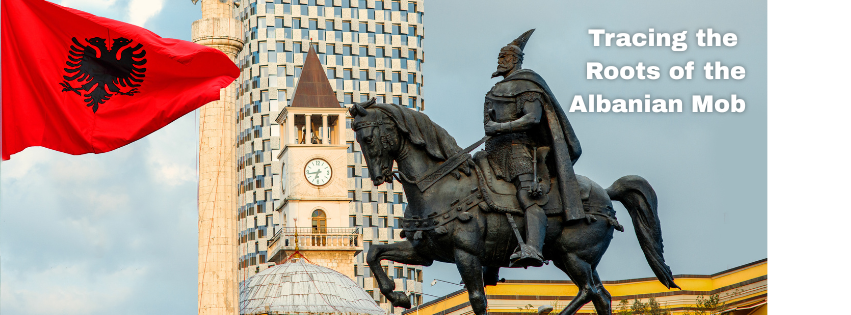
When researching human trafficking for my novel Hollister- The Corridor, I had my choice of criminal gangs to choose from for my main antagonist. I chose Albanian because they are now one of the fastest growing criminal organizations in the world.
Largely unheard of until the end of the Balkan wars in 2000, the Albanian mob has quickly expanded throughout North and South America and Europe. Following the war, which devastated huge swaths of the former Yugoslavia and left many people stateless, a wave of Albanian refugees flooded recipient countries. Unfortunately, among these were many with criminal ties to Albania, Macedonia and the former Kosovo.
War has a way of creating its own problems that extend long after the cessation of battles.
Following WWII, scores of former American GI’s returned to their country feeling lost and abandoned. They became the roots of today’s Hell’s Angels which was formed in 1948 in California. Today, Hells’ Angels are the largest and most international of all outlaw motorcycle gangs in the world, with chapters in 66 different countries.
At the conclusion of the Vietnam war, a mass exodus of Vietnamese refugees emigrated to the West. Faced with systemic challenges including a lack of employment and discrimination, some of the younger men joined criminal gangs which terrorized major cities throughout the 1980’s. Their ties to existing smuggling routes in Southeast Asia made them key players in the heroin trade.
More recently, some refugees from Somalia, Venezuela and Colombia, all countries with recent conflicts, have added to the diaspora of criminal organizations.
All of these criminal organizations play some role in the prevalence of human- and sex-trafficking in Canada, however the Albanian mob stands out for several reasons. Not the least is their ability to collaborate with other criminal organizations including Italians and OMG’s, as I wrote in the novel.
My imagination was stirred when I ran across a news story from 2012. A major Albanian crime boss fugitive from New Jersey, Kutjin “Timmy” Lika, was captured in Toronto after an international manhunt and his being featured on an episode of America’s Most Wanted.
When he was arrested, Lika was living in a second-floor apartment near Eglinton and Mount Pleasant Road. He was described as “disheveled” and no longer living high on the hog. Readers of The Corridor will recognize that I “borrowed” this story in reverse. My character Dobromir flees to New Jersey and evades arrest for several years before he is found living in a second-floor apartment over shops.
While creating the character of Milos Radovan, I knew I wanted to make him somewhat conflicted. Had the war in the Balkans not occurred, Milos may very well have become the corporate executive he aspired to be. Instead, necessity made him a soldier, and he learned an entirely different set of skills. When he emigrated to Canada, he found few legal ways to survive and turned to his connections in the Albanian community. I don’t think he set out to be a master criminal. He made choices along the way that led him to that position over a period of 20 years.
In making him gay, I wanted to contrast his need to hide his true self from the world with his somewhat undeserved reputation as a ruthless monster. In the end, Milos simply wants to find happiness, as most of us do. That he chose the path in life that he did predestined him to never achieve that aspiration.
As I pointed out in the story, of the millions of immigrants who have come to Canada over the last 150 years, a very small number resort to crime, often victimizing their own countrymen in the process. Thankfully, as time passed, each new wave of immigrants has become part of the vast multicultural diaspora that makes Canada such a great country in which to live. So, while I wrote about the Albanian mob, they represent a tiny percentage of the thousands of former Albanians and Kosovans who have made Canada their home.